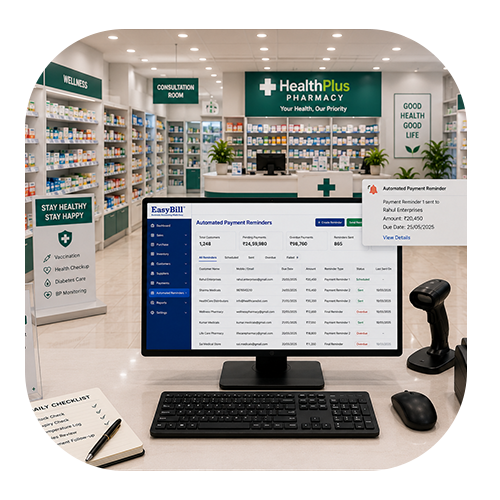
Pharmacy Billing Software Price in India: Monthly vs Lifetime
Pharmacy billing software price in India depends less on the sticker price than on the pricing model behind it. A medical store may be offered a monthly subscription, an annual plan, a desktop licence, or a quote that adds AMC, users, branches, setup, GST, or support. The right comparison is the total cost for the features your pharmacy actually needs. This guide is for medical store owners and pharmacy managers comparing software before buying. If you already use basic billing, the sections on batch tracking, expiry management, GST billing, support and recurring charges will help you compare an upgrade with a new system. What does pharmacy billing software cost in India? There is no single market price. Current public listings show a wide range: some pharmacy products publish free tiers or trials, some start at a few hundred rupees per month, and traditional desktop products may use an upfront licence plus annual maintenance. For example, published listings currently include plans from ₹192/month on one software comparison site, ₹249/month for Thinai MedSuite, and ₹699/year for Bilzy Pharmacy. These are vendor/listing prices, not a universal industry rate, and they should be checked before purchase. citeturn0search9turn0search12turn0search4 Monthly, annual or lifetime: which pricing model is better? A monthly plan is easier to start with. You pay for the period you use the software, which makes it useful when you want to test the workflow before making a larger commitment. An annual plan usually makes the software cost easier to compare over a full year. Some vendors discount annual billing, while others simply publish an annual price. A lifetime or perpetual licence looks different. The initial payment may be higher, but the vendor might separately charge AMC, upgrades, extra computers or support. A lifetime label therefore does not automatically mean zero future cost. Pricing model What to check Best suited to Monthly subscription Monthly fee, users, branches, GST, add-ons Shops wanting low upfront commitment Annual subscription Annual renewal, included features and support Stores comfortable with yearly payment Desktop licence Licence, AMC, upgrades, PCs and installation Stores preferring installed software Lifetime/perpetual What “lifetime” includes and future support charges Buyers prioritising upfront ownership Why the cheapest pharmacy billing software is not always the cheapest Look beyond the first number. A low licence price becomes less attractive if expiry tracking, additional users, support, data backup or another counter costs extra. A slightly higher subscription may be cheaper for a pharmacy that actually needs those functions. One current comparison published in 2026, for example, separates products with published prices from vendors that require a sales quote. Another current pharmacy pricing page lists separate monthly tiers and charges GST in addition to the displayed subscription. citeturn0search1turn0search5 Which features should be included in the price? For a medical shop, billing is only one part of the job. Before comparing pharmacy software price, check whether the quoted plan covers batch-wise stock, expiry tracking, purchase entry, sales reports, GST invoices and the workflows your pharmacy actually follows. Ask the vendor to demonstrate the complete process rather than showing only the billing screen: purchase entry → stock update → sale → return → expiry/stock report. That test tells you more than a feature list. What should you ask about AMC and hidden charges? Ask for the total first-year and renewal cost in writing. These questions matter because two products with similar headline prices may have very different total costs. Is free pharmacy billing software enough for a medical store? Sometimes a free tier is enough to evaluate a product. It is a different question whether it is enough to run a busy medical store. Free plans may limit users, transactions, medicines, reports or advanced functions. A current software comparison lists products with free plans but also notes that limits differ between products. citeturn0search9 Use a free version with your real workflow before deciding. Enter a purchase, create a bill, check stock, process a return and look at the reports. If one of those steps is blocked, the free price is not the full answer. What does a small medical store actually need? A single-counter pharmacy does not need to buy the same package as a multi-branch operation. Start with the workflow, then compare price. For a smaller shop, focus on fast billing, stock control, batch and expiry handling, purchase records, GST invoicing and reliable support. For a growing operation, add user controls, multi-counter or multi-branch support, stronger reporting and integration requirements. [INTERNAL LINK: medical shop billing software] How should you compare two pharmacy software prices? Take the quoted price from each vendor and turn it into a simple three-year view. Include subscription or licence payments, AMC, extra users, counters, branches, setup, support and any required hardware or integrations. For example, a product advertised at ₹X per month should be compared against the complete annual bill, not just ₹X × 12. Replace X with the actual vendor quote before publishing any calculation. [INTERNAL LINK: medical stock management system] What is the best approach for a buyer looking for the cheapest option? Do not start with “Which software is cheapest?” Start with “Which software covers my required pharmacy workflow at the lowest total cost?” That distinction removes a lot of misleading comparisons. A low-cost billing app that lacks the stock or reporting functions you need is not cheap if you have to add another system later. EasyBill: what should you confirm before requesting a price? If you are considering EasyBill, use the same checklist. Confirm the plan that fits your store, the number of users or counters included, supported pharmacy workflows, renewal terms, support, updates and any setup or implementation charges. Do not rely on an old quote if the requirement has changed. [INTERNAL LINK: EasyBill pharmacy billing software] FAQ: Pharmacy billing software price How much does pharmacy billing software cost in India? Prices vary by product and pricing model. Current public listings range from free plans and low monthly subscriptions to annual plans and desktop licences with AMC. Always compare the full cost for
Pharmacy Billing Software Price in India: Monthly vs Lifetime Read More »