
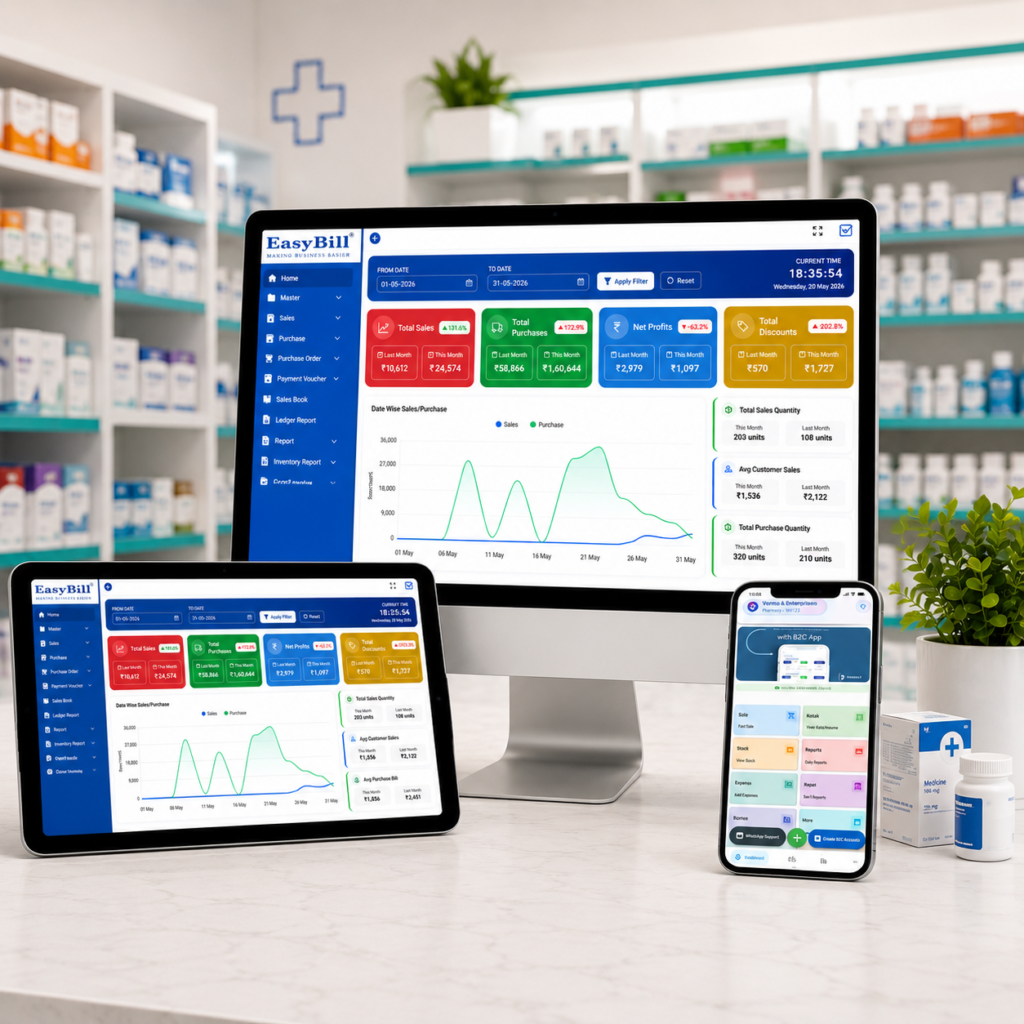
E prescription pharmacy billing software in India should connect prescription information with medicine billing, inventory and customer or patient records. The real benefit is not simply creating a digital prescription. It is reducing duplicate entry between prescription handling, dispensing, billing and stock management.
That sounds straightforward. It isn’t.
The phrase “e-prescription pharmacy billing software” is being used for several different products in the Indian healthcare market. Some are doctor-side prescription systems. Some are hospital pharmacy systems. Others are retail pharmacy billing platforms that store prescription information.
Before buying, you need to know which one you actually need.
What does e-prescription pharmacy billing software actually do?
Think about the counter rather than the software brochure.
A doctor creates an electronic prescription. The pharmacy receives or accesses the prescription. The pharmacist checks the medicines, selects the required products, completes the sale and generates the invoice. The medicine sale should then be reflected in inventory.
That is the workflow worth testing.
Some Indian pharmacy systems already advertise this type of connection. Lifetrenz describes receiving e-prescriptions from OP, IP, emergency and daycare workflows and providing one-click dispensing and billing. VistaMed describes e-prescriptions flowing from its EMR into the pharmacy dispensing list, followed by billing and inventory activity.
A basic retail billing application is different. It may handle medicine sales, GST invoices, stock, purchases and reports without receiving electronic prescriptions directly from a doctor or clinic.
Neither approach is automatically wrong. The right choice depends on how your pharmacy receives prescriptions.
[INTERNAL LINK: Pharmacy Billing Software]
Are you actually looking for pharmacy software or e-prescription software?
This is the first question I’d ask before taking a demo.
Doctor-side e-prescription software
This is primarily used by doctors and clinics. It may include patient registration, consultation notes, electronic prescriptions, medical history and prescription sharing.
Pharmacy billing software
This is primarily used by the pharmacy. The focus is usually billing, medicine inventory, purchases, sales, batch and expiry management, customer records and reports.
Integrated pharmacy management software
This sits between the two workflows. The pharmacy may receive electronic prescriptions from a clinic or hospital system and then process them through dispensing and billing. Hospital-oriented platforms such as VistaMed and Lifetrenz describe this model.
If you run a standalone medical store, don’t buy a hospital system simply because it has more features.
More screens do not automatically mean a better pharmacy.
What should happen after an electronic prescription reaches the pharmacy?
This is the demo I recommend.
Ask the vendor to show one prescription from beginning to end.
Prescription received → patient identified → medicines selected → stock checked → bill generated → stock updated → transaction retained.
Don’t let the demonstration stop at the prescription screen.
The billing counter is where the software earns its keep.
A good workflow should make the relationship between prescription, medicine and sale easy for the authorized pharmacy staff to understand. Depending on the product, the prescription might arrive from an integrated clinic/HMS, be entered manually, or be attached to a customer/patient record.
The vendor should explain exactly which workflow their product supports.
Which features matter most in 2026?
Feature lists are easy to manufacture. Workflow is harder.
Prescription records that staff can actually find
If your pharmacy retains prescription information digitally, searching should be straightforward.
Ask: Can staff search by patient/customer? Can previous prescriptions be retrieved? Can the prescription be linked to the sale? Can authorized users see prescription history? What happens if the prescription is updated or corrected?
Don’t assume the answer because a website says “digital prescription management.” Make them demonstrate it.
Medicine inventory connected to billing
An electronic prescription is not useful to the pharmacy if staff still have to create the sale from scratch.
The software should fit into the medicine inventory process.
Check whether the system handles medicine stock, purchase records, batch information, expiry information, sales, returns, supplier records and low-stock reporting.
EasyBill’s pharmacy software positioning includes pharmacy billing and inventory workflows, including medicine stock, purchases and related business reporting.
[INTERNAL LINK: Medical Stock Management Software]
Batch and expiry tracking
Suppose the same medicine exists in more than one batch. Your software needs to make batch and expiry information visible during the relevant stock and sales workflow.
Some pharmacy-management systems specifically advertise automated batch/expiry handling. Lifetrenz, for example, describes expiry-based dispensing and expiry alerts.
But don’t assume every billing product works this way. Ask the vendor to demonstrate it using actual stock.
GST billing
For an Indian pharmacy, prescription handling does not remove the need for proper billing.
The software should fit your existing invoicing workflow, including whatever GST configuration applies to your business.
Don’t accept a generic statement such as “100% GST compliant” without asking what the software actually calculates, stores and reports.
[INTERNAL LINK: GST Billing Software for Pharmacy]
Is e-prescription legally valid in India?
This is where software marketing needs a little caution.
India’s Telemedicine Practice Guidelines, issued on 25 March 2020, provide a framework for registered medical practitioners providing healthcare through telemedicine.
The National Medical Commission’s 2023 regulations also state that signatures on prescriptions and other clinical documents should carry the RMP’s name and NMC registration number, and that electronic generation of orders/prescriptions may help automate this information.
So don’t reduce the issue to “digital prescription = automatically compliant.”
The prescription must be generated within an appropriate professional workflow, and the pharmacy still has its own responsibilities when dispensing medicines.
A pharmacy software vendor should be able to explain how its prescription workflow handles the information it actually receives.
What about patient data?
An e-prescription contains personal and health-related information. That changes the software-buying conversation.
India’s Digital Personal Data Protection Act, 2023 establishes a legal framework concerning the processing of digital personal data.
For a pharmacy evaluating cloud software, ask practical questions instead of accepting a vague “secure” badge:
Where is the data hosted? Who can access prescription records? Are user permissions available? Are backups performed? Can access be restricted by staff role? What happens when an employee leaves? How is data exported if you change software?
The answers are more useful than a generic security paragraph.
What is the difference between e-prescription and a photo of a prescription?
This gets confused surprisingly often.
A photograph or scanned copy is simply a digital image of a document.
An electronic prescription can contain structured information such as medicine details, dosage instructions and prescriber information. Some clinical platforms use structured drug databases and connect the prescription to a patient’s record.
For a pharmacy, the important question is what the software receives.
If the system receives only an image, the pharmacist may still need to read and enter the medicine information.
If the system receives structured prescription data through an actual integration, the workflow may be different.
Ask the vendor to show you the exact process.
Who should buy this type of software?
A standalone retail pharmacy usually has different requirements from a hospital pharmacy.
Standalone medical stores
Prioritize billing, inventory, purchases, batch/expiry management, customer records and reports. If prescriptions are mostly paper or images, a full hospital e-prescription platform may be unnecessary.
Hospital pharmacies
Integration becomes much more important. Hospital pharmacy platforms may connect prescriptions with OP/IP workflows, dispensing and patient billing.
Clinic-attached pharmacies
The key question is whether the clinic’s prescription system can communicate with the pharmacy system.
Don’t assume two products will integrate just because both advertise “e-prescription.” Ask about the actual integration method.
Multi-store pharmacy businesses
Here the bigger issue becomes centralized visibility. You may need branch-wise inventory, billing, user permissions and consolidated reporting. Whether e-prescription integration is necessary depends on how prescriptions enter the business.
Who does not need e-prescription pharmacy software?
A small medical shop that receives prescriptions on paper, bills customers at the counter and mainly needs stock and accounting control may not need a full e-prescription ecosystem.
A normal pharmacy billing solution could be enough.
This is one of the places where buyers overspend: they purchase software designed for hospitals when their actual problem is faster billing and better stock control.
Start with the workflow. Then buy the features.
What should you ask during the software demo?
Use a real pharmacy scenario.
Give the salesperson a prescription and ask them to show:
- How the prescription enters the system.
- How the patient/customer is identified.
- How medicines are selected.
- How stock and batch information appears.
- How the bill is generated.
- What happens to inventory after the sale.
- Where the prescription history is stored.
- Which users can access the record.
- How the information is backed up or exported.
- Whether the pharmacy can continue its normal billing workflow if the e-prescription integration is unavailable.
That last question gets ignored. It shouldn’t.
A pharmacy counter still needs to function when an external system or integration has a problem.
Where EasyBill fits for Indian pharmacies
EasyBill ERP is positioned around pharmacy billing and inventory management rather than pretending that every medical store needs a full hospital information system.
Its pharmacy offering covers the operational side of running a medical store, including billing, stock and purchase-related workflows.
That makes the buying decision straightforward.
If your primary problem is pharmacy billing + inventory + medicine management, start by testing that workflow.
If your requirement is specifically doctor e-prescription → pharmacy → dispensing → billing, ask whether the exact integration you need is available before purchasing.
[INTERNAL LINK: Pharmacy POS Software]
Don’t buy an e-prescription feature because the words sound modern. Buy the workflow your pharmacy actually needs.
Frequently Asked Questions
What is e prescription pharmacy billing software?
It refers to software that combines or connects electronic prescription handling with pharmacy billing and related medicine-management processes. The exact capabilities differ between retail pharmacy, clinic and hospital systems.
Is e-prescription software the same as pharmacy billing software?
No. E-prescription software is primarily concerned with creating, managing or transmitting prescriptions, while pharmacy billing software focuses on medicine sales, invoices, inventory and related pharmacy operations. Some platforms combine both.
Can an e-prescription automatically create a pharmacy bill?
Some integrated systems advertise prescription-to-dispensing and billing workflows. Whether this is available depends on the specific integration and product configuration.
Can a small medical store use e-prescription software?
Yes, but a small store should first determine whether it actually needs direct e-prescription integration. If most prescriptions arrive as paper documents or images, pharmacy billing and inventory software may address the main operational requirement.
Does e-prescription software replace a pharmacist’s professional judgment?
No. Software organizes information and supports workflow. It does not replace the professional responsibilities involved in reviewing and dispensing medicines.
What should I check before buying pharmacy billing software with e-prescription?
Test the complete workflow rather than individual features: prescription receipt, patient identification, medicine selection, stock, batch/expiry information, billing, inventory update, record access and data export.
The practical next step
Don’t compare ten software websites based on feature counts.
Take one real prescription workflow from your pharmacy and ask each vendor to demonstrate exactly what happens from prescription received to medicine dispensed and bill generated.
If the software still requires your staff to type the same information into multiple places, keep looking.
If it fits your actual counter workflow, then compare the billing, inventory, security, integration and support details before making the purchase.