
Last updated: October 5, 2026
Quick answer: Pharmacy software with batch management records each medicine batch with stock and expiry details, then connects that information with purchases, sales and billing. For a medical store, the useful test is simple: can staff find the right batch, see what is nearing expiry and keep stock updated without maintaining a second manual register?
This guide is for medical store owners, pharmacists and pharmacy managers who already understand basic billing and inventory but need tighter control over batch-wise stock and medicine expiry.
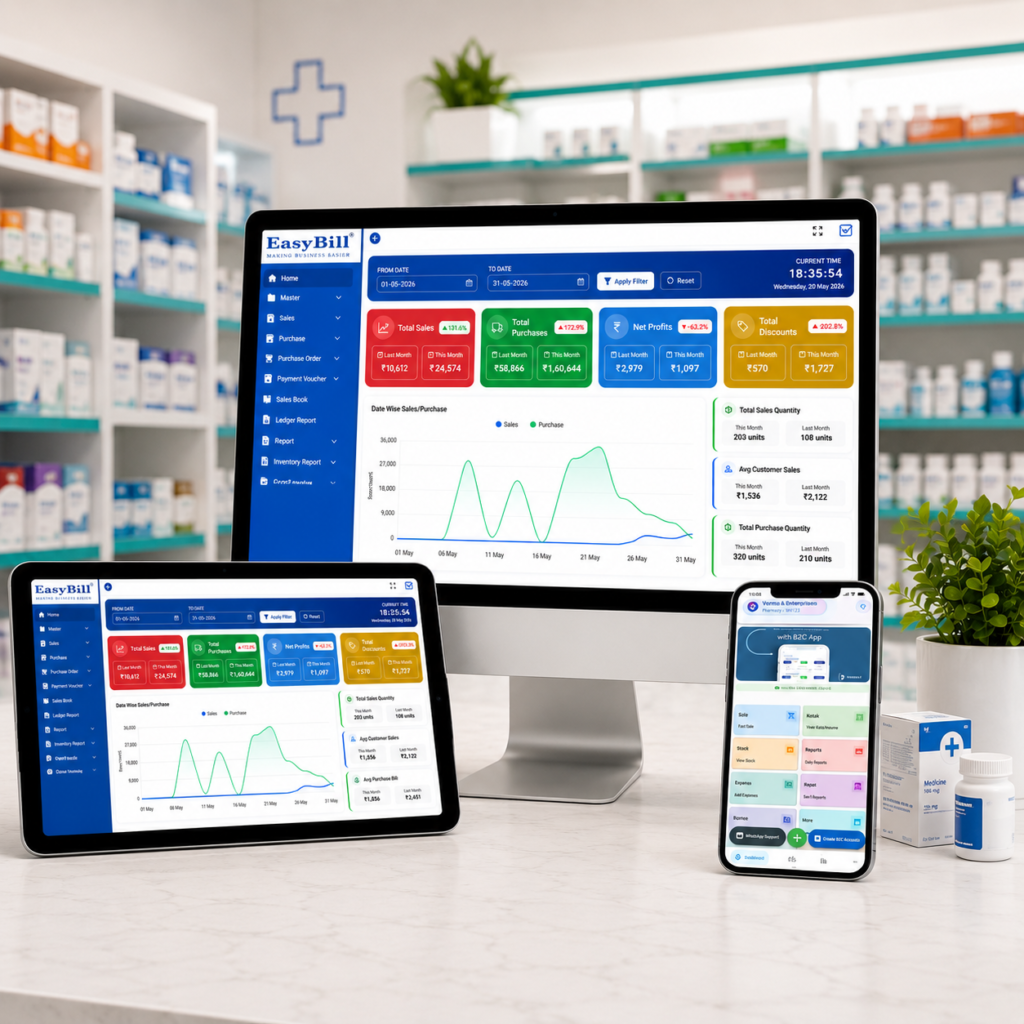
Batch management is where ordinary stock counting stops being enough. A pharmacy may have the same medicine in more than one batch, with different purchase dates and expiry dates. If those records are mixed together, the owner has to check the physical shelf or a separate register before deciding which stock needs attention.
A connected system keeps the batch record with the medicine inventory. That is the real reason to look for pharmacy software with batch management, rather than choosing a billing program that only prints invoices.
What should pharmacy batch management actually do?
A practical batch-management workflow should let the pharmacy record a medicine, its batch number, quantity and expiry information when stock is received. The same stock information should remain available when the medicine is sold, reviewed in inventory or included in a report.
That connection matters more than a long feature list. If batch information lives in one place and billing lives somewhere else, staff still have to reconcile the two.
Why batch-wise inventory matters in a pharmacy
Suppose the same product arrives from a supplier twice. The product name is identical, but the batches are different. Treating the medicine as one undifferentiated stock figure hides the information that matters for expiry review and stock decisions.
Batch-wise records give the pharmacy a more useful view: product, batch, quantity and expiry information together. This is also why medicine expiry date tracking software works best when expiry is attached to the actual stock batch rather than treated as a separate reminder list.
Which features should you check before buying?
- Batch-wise stock: the same medicine should be distinguishable by batch.
- Expiry-date recording: expiry information should stay connected to the relevant stock.
- Purchase-to-stock linkage: incoming stock should update inventory records rather than creating a separate paper trail.
- Billing integration: sales should be connected to inventory so stock does not have to be updated twice.
- Expiry review or alerts: staff should have a clear way to identify stock that needs attention before expiry.
- Stock reports: owners should be able to review quantities and movement without rebuilding the figures manually.
- Returns and corrections: the workflow should handle common stock adjustments without destroying the original record.
How does pharmacy expiry alert billing software help?
Pharmacy expiry alert billing software connects the expiry problem with the place where stock is already being managed: the billing and inventory system. Instead of keeping a separate spreadsheet just for expiry dates, the team can review expiry-sensitive stock from the same inventory workflow.
The important question is not whether a vendor uses the word “alert.” Ask what actually triggers the alert, where staff see it, whether it is linked to a specific batch, and what report is available for near-expiry stock. If the answer is vague, test the workflow during the demo.
Batch management and expiry tracking are not the same thing
They work together, but they solve different parts of the problem.
Batch management tells you which stock group you are holding. Expiry tracking tells you when that stock needs attention. A useful pharmacy system connects both so the expiry date is tied to the correct batch and remaining quantity.
This distinction is easy to miss in software comparisons. A system that stores one expiry date against a product is not the same as a system that stores expiry information against individual batches.
What does the workflow look like from purchase to sale?
- Receive the medicine: record the product and relevant batch information with the incoming stock.
- Store the batch: keep quantity and expiry information attached to that batch in inventory.
- Sell the medicine: connect the sale to the inventory workflow so stock is reduced from the recorded quantity.
- Review ageing stock: use the expiry view or report to identify batches that need attention.
- Act on the stock: follow your pharmacy’s approved process for sale, supplier return, adjustment or disposal of stock that cannot be sold.
The workflow is simple. The value comes from keeping the records connected.
What is the difference between manual records and batch-management software?
| Area | Manual approach | Batch-management software |
|---|---|---|
| Batch identification | Checked across registers or spreadsheets | Stored with product records |
| Expiry review | Requires manual checking | Can be reviewed from inventory reports or alerts |
| Stock update after sale | May require separate entry | Connected to billing when the software supports it |
| Purchase history | Separate records | Linked to inventory in the same workflow |
| Reporting | Manual compilation | Generated from recorded transactions |
Who actually needs pharmacy software with batch management?
A small chemist does not need software simply because every competitor has it. The stronger case appears when the store has multiple batches of the same medicines, a growing product catalogue, frequent purchases, more than one person handling stock, or regular expiry reviews.
It is also useful for pharmacies that want billing and inventory to work as one process rather than maintaining separate records for sales and stock.
How EasyBill ERP fits the pharmacy workflow
EasyBill ERP positions its pharmacy solution around billing, inventory, purchases, GST invoicing and business reporting. Its published pharmacy and inventory material also describes batch and expiry information as part of the stock workflow. See EasyBill ERP for the current product overview.
For the broader stock-management picture, see Medical Stock Management System. For the billing side, see Pharmacy Billing Software for Small Business.
If expiry alerts are the main reason you are evaluating software, do not rely on a feature name alone. Ask for a live demo using your own sample medicine batches and check exactly how the expiry list, batch information and billing workflow behave.
What should you test in a software demo?
- Add the same medicine with two different batches and expiry dates.
- Sell stock and confirm that the inventory changes correctly.
- Open the batch or expiry view and check whether the correct batch is identifiable.
- Run an expiry-related report and confirm what information it actually shows.
- Record a purchase and check whether the new batch appears in inventory.
- Test a return or stock correction and confirm that the records remain understandable.
This is a better test than asking a salesperson to read the feature list. Use a realistic workflow and see what the staff member actually has to click.
What should you not expect from batch-management software?
Software does not replace stock discipline. Incorrect batch or expiry data entered at purchase will still produce incorrect records. Staff also need a defined process for physical stock checks, supplier returns, damaged stock and products that have reached expiry.
That is why I would judge a system on the quality of its workflow rather than the number of pharmacy features printed on its sales page.
Frequently Asked Questions
What is pharmacy software with batch management?
It is pharmacy billing and inventory software that keeps medicine batch information connected with quantities, purchases, sales and expiry details so stock can be reviewed at batch level.
Can pharmacy software track medicine expiry dates?
Yes, pharmacy inventory systems can record expiry information with stock batches. The exact alert method and warning periods depend on the software, so verify those details during a demo.
What is medicine expiry date tracking software?
Medicine expiry date tracking software records expiry information against medicine stock and helps staff identify products that need attention before their expiry date. The strongest setup connects expiry tracking to batch-level inventory.
Does batch management help with pharmacy billing?
Yes. When batch and inventory records are connected to billing, the pharmacy can maintain a clearer link between medicine sales and the stock recorded in the system.
Is batch management useful for a small medical store?
It is useful when the store needs to distinguish batches, monitor expiry dates, manage purchases and keep billing connected with stock. A very small store with simple inventory may need fewer features.
What should I ask before buying pharmacy expiry alert billing software?
Ask how batches are recorded, how expiry dates are attached to stock, when alerts appear, which users receive them, what reports are available, how sales affect stock and how returns or corrections are handled.
The practical buying decision
If batch and expiry control is the reason you are changing software, make those two workflows the centre of the demo. Do not settle for a billing screen that happens to have an expiry field.
Choose a system that keeps batch, expiry, stock, purchase and billing records connected and understandable to the person actually working at the pharmacy counter. For EasyBill ERP, the next sensible step is to test that workflow with your own medicines and sample batches before making a purchase decision.