
CRM in the pharma industry is no longer just a contact database. The right system gives pharmaceutical sales teams a structured way to manage healthcare-professional relationships, distributors, leads, field activities, follow-ups and commercial reporting while keeping sensitive workflows under control.
For a pharma business evaluating CRM software in 2026, the better question is simple: does the system fit the way your sales team actually works? A long feature list is less useful than a CRM that gives representatives the right customer information before a visit, records what happened after it and gives managers a clear view of what needs attention next.
What is CRM in the pharma industry?
CRM in the pharma industry means customer relationship management software adapted to pharmaceutical sales, marketing and customer-engagement workflows. Depending on the platform, it may manage healthcare-professional profiles, distributors, customers, leads, field visits, sales opportunities, communication history, marketing activity and reporting.
Pharma CRM is different from a basic sales CRM because the customer structure is more complicated. A sales team may interact with doctors, hospitals, pharmacies, chemists, distributors, stockists and other business partners. Current pharma CRM products from vendors such as Salesforce, TatvaCRM and Groweon emphasize centralized customer information, field activity, distributor management and sales workflows. Salesforce Life Sciences and TatvaCRM’s pharma CRM guide provide examples of these industry-specific workflows.
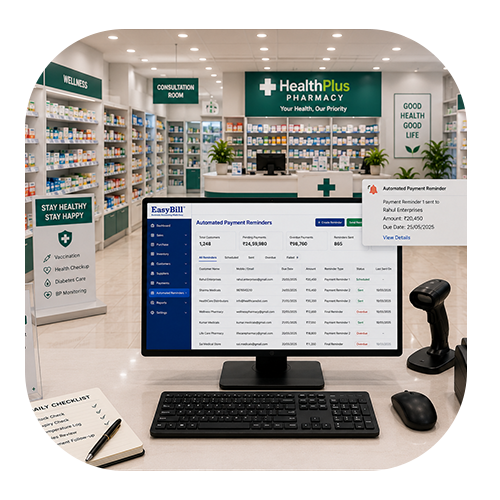
Why does pharma need a specialized CRM?
A normal CRM can store a name, phone number, email address and sales opportunity. That is only the beginning for a pharmaceutical organization.
Pharma sales teams may need to organize customer relationships by territory, record field interactions, plan follow-ups and give managers visibility into representative activity. A system designed around those workflows reduces the amount of information that stays inside individual notebooks, spreadsheets or messaging conversations.
That is one of the strongest reasons to use CRM software in pharma: the business gets a shared record of customer activity instead of depending on one salesperson’s memory.
Which pharma CRM features matter most?
1. Healthcare professional and customer profiles
The CRM should give the sales team a useful profile for each relevant contact. Depending on the business model, this could include doctors, hospitals, pharmacies, chemists, distributors and stockists.
The profile should answer a practical question before the next interaction: who is this customer, what happened last time, and what should happen next?
2. Lead management
New enquiries need an owner and a next action.
A good CRM records the lead source, assigned salesperson, customer requirements, stage and follow-up history. That prevents a common problem: several people believe somebody else is handling the enquiry.
Pharma-focused CRM platforms such as Groweon explicitly position lead management and follow-up tracking as core workflows. Groweon’s pharma CRM workflow describes lead-to-conversion stages alongside customer, distributor and field-sales management.
3. Field force management
If medical representatives work outside the office, mobile access is not an optional extra. The representative needs customer information, visit records and follow-up tasks while working in the field.
Some pharma CRM products also support visit verification, territory planning, route management and activity reporting. These features vary by vendor, so ask for a live demonstration rather than assuming every pharma CRM includes them. Current field-sales products describe GPS check-ins, offline visit logging, route planning and visit reporting as examples of specialized capabilities. Lavisho TT’s pharmaceutical CRM page documents these field-sales functions.
4. Distributor and stockist management
Pharma sales do not stop at the end customer. Distributors and stockists can be central to order flow and territory performance.
A useful CRM should make these relationships easy to search and report on. TatvaCRM describes pharma CRM around distributor networks, medical representatives and orders, while other industry-specific systems provide account classification and territory-based sales workflows.
5. Follow-up and task management
CRM software earns its place when it tells the salesperson what needs to happen next.
That might be a scheduled call, a customer meeting, a quotation, a distributor follow-up or another sales activity. The manager should also be able to identify overdue activities without collecting separate spreadsheets from every representative.
How does CRM improve pharma sales management?
The biggest change is visibility.
A sales manager can move from asking, “What happened this week?” to reviewing structured activity: which accounts were visited, which leads are progressing, which follow-ups are overdue and which territories need attention.
CRM platforms also support segmentation and campaign management. RT Dynamic describes pharma CRM use for customer segmentation, coordinated marketing campaigns, key-account management and sales planning. RT Dynamic’s pharma CRM overview provides examples of these workflows.
CRM, ERP and pharmacy billing software are different
This distinction saves buyers from purchasing the wrong product.
| Business requirement | CRM | ERP / Billing software |
|---|---|---|
| Lead capture | Core function | Usually secondary |
| Customer relationship history | Core function | Usually operational |
| Field visits | Common in pharma CRM | Usually not the main focus |
| Sales pipeline | Core function | May be transaction-focused |
| Billing and invoices | Usually not the core function | Core function |
| Inventory and stock | Usually limited or integrated | Core function in many ERP systems |
| GST and business reports | Not normally the primary purpose | Common requirement |
A pharma company may need both. CRM manages the relationship and sales side; ERP, pharmacy or billing software manages operational transactions. If these systems are disconnected, employees end up maintaining duplicate customer information.
[INTERNAL LINK: Pharmacy Stock Management Software]
[INTERNAL LINK: ERP Software for Pharmaceutical Industry]
[INTERNAL LINK: GST Reports Billing Software]
What about AI in pharma CRM in 2026?
AI is becoming part of the CRM discussion, but it should be evaluated as a workflow feature rather than a marketing label.
Current life-sciences CRM platforms describe AI-assisted capabilities such as preparing sales calls, generating summaries, recommending next actions and assisting customer engagement. Salesforce’s current Life Sciences Cloud materials describe AI-powered capabilities, unified HCP profiles and AI-assisted customer engagement. Salesforce Life Sciences Cloud.
The sensible question for a buyer is not “Does it have AI?” Ask instead: What work does the AI actually remove, what data does it use, and what approval controls exist before an output reaches a healthcare professional?
Compliance should be part of the CRM evaluation
Pharmaceutical sales involve regulated products and sensitive business processes. CRM selection therefore needs more than a discussion about dashboards.
Ask how the platform handles permissions, audit history, data access, user roles, customer information and approved communication workflows. The exact regulatory requirements depend on the markets and activities of the pharmaceutical company, so compliance should be checked with the organization’s legal and regulatory teams.
Do not accept a generic statement such as “fully compliant” without asking what controls are actually provided.
How should you evaluate CRM in the pharma industry?
Use your own sales process during the demo. A polished presentation is not enough.
- Create a real doctor, hospital, pharmacy or distributor profile.
- Assign a lead to a representative.
- Record a field interaction and schedule the next follow-up.
- Move the opportunity through your actual sales stages.
- Check what the sales manager sees from the same activity.
- Test the mobile application if representatives work in the field.
- Check integration with ERP, inventory, billing or other systems already used by the business.
- Ask how data access, permissions, audit records and exports work.
That test exposes weak software quickly.
Who should invest in pharma CRM?
A pharma company with multiple representatives, territories, customer groups or distributor relationships has a strong reason to evaluate a dedicated CRM. The case becomes stronger when managers need structured reporting instead of manually collected activity updates.
A very small operation with one salesperson and a simple customer list may not need an enterprise-grade pharma CRM. A basic CRM or a business-management system may cover the requirement.
There is another boundary. If the main problem is medicine inventory, batch tracking, expiry management, purchasing or pharmacy billing, CRM is not the answer. Solve the operational problem first, then connect customer and sales workflows where required.
What should a pharma CRM buyer avoid?
Buying on the feature count. Fifty checkboxes do not tell you whether the daily workflow is usable.
Ignoring mobile use. If representatives work outside the office, test the actual mobile workflow with real scenarios.
Leaving integration until the end. Ask early how CRM data connects with billing, inventory, ERP, marketing or reporting systems.
Automating a broken process. First define who owns a lead, what qualifies an opportunity and what the next action should be. Then automate reminders and assignments.
Is CRM worth it for a pharma business?
Yes—when the business has enough sales activity that customer information, follow-ups and field reporting are becoming difficult to control manually. The value comes from a shared sales record and a repeatable process, not from simply installing another application.
For a pharmaceutical organization, I would shortlist CRM products by starting with the field workflow, customer structure and integration requirements. Then test the software using actual sales scenarios. If the vendor cannot show how your team will create a lead, visit a customer, record the interaction, schedule the next action and report the result, keep looking.
Frequently asked questions
What does CRM mean in the pharma industry?
CRM means customer relationship management. In pharma, it refers to systems adapted to pharmaceutical sales and customer engagement, including workflows for healthcare professionals, customers, distributors, field representatives, leads and reporting.
What is the main purpose of pharma CRM?
The main purpose is to organize customer information and sales interactions so representatives and managers have a shared view of relationships, activities, opportunities and follow-ups.
Can pharma CRM manage medical representatives?
Many pharma-specific CRM platforms include field-force features such as visit planning, activity capture, follow-ups and mobile access. Exact features vary by product and should be verified during a demo.
Is pharma CRM the same as pharmacy billing software?
No. CRM focuses on relationships, sales activities and follow-ups. Pharmacy billing software focuses on transactions such as billing, inventory and business reporting. Some businesses use both and connect them.
What is the best CRM for the pharma industry?
There is no single best system for every pharmaceutical company. The right choice depends on sales structure, field-force requirements, customer types, integration needs, reporting, security and compliance requirements. Test the software with your real workflow before buying.
Recommended next step: shortlist two or three CRM platforms and run the same five real sales scenarios in each. Compare the workflow, mobile experience, reporting and integration—not just the feature list.