
Pharma ERP Software: Manufacturing, Stock & Batch Management
At a glance: ERP Software for Pharmaceutical Industry connects inventory, batch and expiry records, purchasing, GST billing, sales and reporting for pharmaceutical businesses. Keeping these activities together can reduce repeated data entry and give teams a clearer view of day-to-day operations.
What to check: Before selecting pharmaceutical ERP software, test the workflows your team actually uses—stock entry, batch and expiry tracking, purchases, GST billing, sales, reports, user permissions and multiple locations. Realistic sample data will give you a more useful picture than a feature list alone.
Last updated: September 7, 2026
Reviewed by: EasyBill ERP Team
ERP Software for Pharmaceutical Industry is an integrated business management solution for pharmaceutical businesses. The right system depends on the operating model: manufacturers need production, formulation, batch traceability and quality workflows, while distributors and pharmacies focus more on inventory, purchasing, batch/expiry, sales and billing.
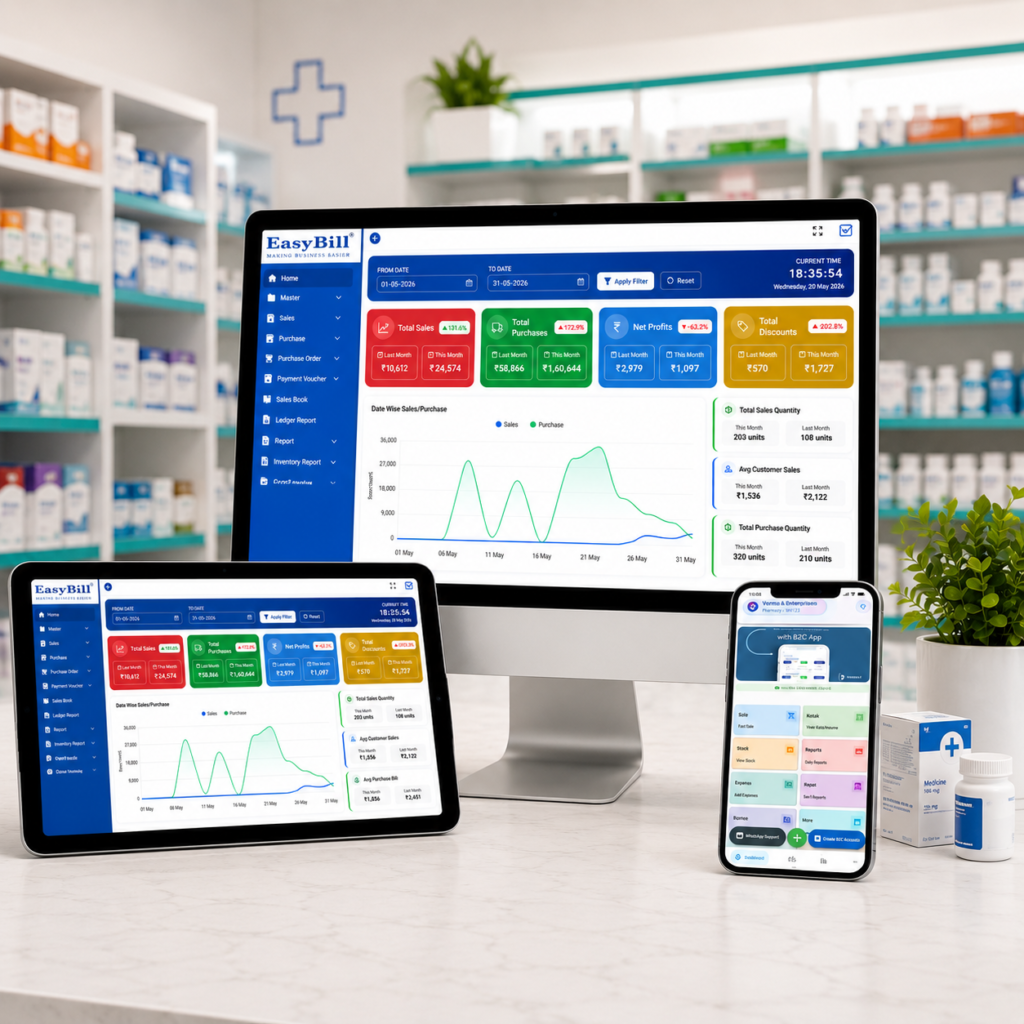
What is ERP Software for Pharmaceutical Industry?
ERP Software for Pharmaceutical Industry is an integrated business management solution that connects inventory, purchasing, sales, accounting, production, distribution, and reporting into a single platform. It enables pharmaceutical businesses to manage every department efficiently while ensuring data accuracy and regulatory compliance.
When different teams keep separate spreadsheets or applications, the same information often has to be entered more than once. An ERP system brings those records together so staff can work from a shared view of inventory, purchases, sales and other business activity.
Why Does a Pharmaceutical Business Need ERP Software?
Direct answer: A pharmaceutical ERP becomes useful when a business needs one workflow for stock, purchases, batches, expiry dates, sales, GST billing and reporting instead of maintaining these records separately.
| Business need | What to test in the software |
|---|---|
| Inventory | Stock by product, location and transaction |
| Batch control | Batch number and expiry records |
| Purchasing | Supplier, purchase and stock receipt workflow |
| Sales | Billing and stock deduction |
| Reporting | Sales, purchase and inventory reports |
Direct answer: Pharmaceutical businesses need ERP software when inventory, batches, expiry dates, purchases, sales, billing and compliance become difficult to manage accurately with separate spreadsheets or manual records.
Which Pharmaceutical ERP Workflows Should You Test Before Buying?
Direct answer: Test the workflows that affect stock accuracy first: purchase entry, batch and expiry capture, sales, returns, GST billing, reporting and stock movement between locations. A feature list is less useful than seeing the software handle your actual sample transactions.
For retail pharmacy operations, see pharmacy billing software. For distribution-focused workflows, see pharma distribution software.
Direct answer: Pharmaceutical ERP software improves operations by connecting purchasing, inventory, batch and expiry records, sales, GST billing and reporting so teams can work from consistent business data.
Pharmaceutical operations depend on accurate stock records, batch details and expiry information. When these records are maintained manually, it becomes easier to miss a stock change, overlook an expiry date or spend extra time checking transactions.
Using ERP Software for Pharmaceutical Industry helps businesses automate routine tasks, improve productivity, and reduce operational risks.
Pharma ERP Modules: Manufacturing, Distribution & Pharmacy
Manufacturing ERP vs pharmacy ERP: are they the same?
No. The overlap is in inventory, purchasing, sales, billing and reporting, but a manufacturing workflow can require production-specific records while a pharmacy or distribution workflow focuses more on purchasing, batch/expiry, sales and stock movement.
| Business type | Core workflow to test |
|---|---|
| Pharmaceutical manufacturer | Production, batch traceability, inventory, purchasing and quality-related records |
| Distributor/wholesaler | Purchase, batch/expiry, warehouse stock, sales and delivery |
| Retail pharmacy | Counter billing, batch/expiry, barcode, customer and stock |
| Hospital pharmacy | Dispensing, stock, purchase, issue/return and reporting |
For pharmacy-specific billing, see pharmacy billing software. For distribution workflows, see pharma distribution software.
Direct answer: Pharma ERP modules should match the business workflow. A manufacturer may need production and batch traceability, while distributors need warehouse, purchase and delivery controls and pharmacies need billing, barcode, batch/expiry and retail inventory. Common modules include inventory, purchasing, GST billing, accounting, reporting, multi-location management and user security.
1. Inventory Management
Track medicine inventory in real time across multiple warehouses and business locations.
2. Batch & Expiry Management
Monitor batch numbers and expiry dates to reduce medicine wastage and ensure product safety.
3. Purchase Management
Manage suppliers, create purchase orders, and update inventory automatically after receiving stock.
4. Sales & GST Billing
Generate GST-compliant invoices while automatically updating inventory after every sale.
5. Barcode Integration
Use barcode scanning for faster billing, stock verification, and inventory management.
6. Multi-Warehouse Management
Manage inventory across multiple branches, warehouses, and distribution centers.
7. Supplier & Customer Management
Maintain complete records of suppliers, distributors, customers, and payment history.
8. Accounting Integration
Manage accounts, payments, receivables, expenses, and financial reports from one platform.
9. Reports & Business Analytics
Generate sales reports, stock reports, purchase analysis, profit reports, and inventory valuation instantly.
10. User Role & Security
Provide secure role-based access to employees while protecting sensitive business information.
Benefits of ERP Software for Pharmaceutical Industry
Implementing ERP Software for Pharmaceutical Industry offers several business advantages. For related pharmacy workflows, see our Pharmacy Billing Software guide and GST Billing Software guide.
- Improved inventory accuracy
- Better batch and expiry tracking
- Faster GST billing
- Reduced manual errors
- Better purchase planning
- Increased operational efficiency
- Improved financial management
- Enhanced regulatory compliance
- Better customer satisfaction
- Higher business profitability
Who Should Use ERP Software for the Pharmaceutical Industry?
Direct answer: Pharmaceutical manufacturers, medicine distributors, wholesale and retail pharmacies, hospital pharmacies and healthcare supply businesses can use ERP software to manage inventory, purchasing, billing, sales and reporting.
This solution is ideal for:
- Pharmaceutical Manufacturers
- Medicine Distributors
- Wholesale Pharmacies
- Retail Pharmacies
- Hospital Pharmacies
- Medical Stores
- Healthcare Distributors
- Surgical Equipment Suppliers
- Diagnostic Centers
- Healthcare Supply Chain Businesses
Why Choose EasyBill ERP for Pharmaceutical Businesses?
Request a demo: See how EasyBill ERP handles your actual pharmaceutical workflow, including stock, batches, expiry, purchasing, billing, reporting and multi-location requirements.
Direct answer: EasyBill ERP brings billing, inventory, purchases, batch and expiry tracking, accounting and business reports into one platform for businesses that need connected pharmaceutical workflows.
EasyBill ERP is a complete ERP Software for Pharmaceutical Industry designed to simplify inventory management, billing, accounting, and business operations.
EasyBill ERP offers:
- Pharmaceutical Inventory Management
- Batch & Expiry Tracking
- GST Billing
- Barcode Billing
- Purchase Management
- Sales Management
- Supplier Management
- Accounting
- Business Reports
- Multi-Store Management
- Cloud-Based Access
- Secure Data Backup
- User Permission Management
Whether you manage a pharmaceutical manufacturing company, wholesale distribution business, or retail pharmacy, EasyBill ERP helps streamline operations and improve business performance.
How Should You Choose ERP Software for the Pharmaceutical Industry?
Direct answer: Choose ERP software by testing pharmaceutical inventory, batch and expiry workflows, purchases, GST billing, sales, reporting, user permissions and multi-location requirements before implementation.
Pharmaceutical ERP Evaluation Checklist
- Add sample medicines and opening stock.
- Enter batch numbers and expiry dates and verify the records.
- Record a sample purchase and confirm the inventory update.
- Create a GST invoice and check tax and stock calculations.
- Review sales, inventory, purchase and financial reports.
- Test user permissions, backup and multi-location workflows.
Practical Pharmaceutical ERP Testing Example
For a repeatable demo, use 20 sample medicines with batch numbers, expiry dates and opening stock. Record one purchase, one sale and one GST invoice, then compare the expected stock balance and reports with the software results before adopting the workflow.
Before selecting an ERP solution, ensure it includes:
- Easy-to-use interface
- Inventory management
- Batch and expiry tracking
- GST billing
- Barcode support
- Multi-location management
- Accounting integration
- Real-time reporting
- Cloud backup
- Reliable customer support
Frequently Asked Questions About Pharmaceutical ERP Software
What is ERP software for the pharmaceutical industry?
ERP software for the pharmaceutical industry is a centralized system for managing inventory, purchases, sales, billing, accounting, batch and expiry records and business reports.
Who should use pharmaceutical ERP software?
Pharmaceutical manufacturers, distributors, wholesalers, pharmacies, hospital pharmacies and healthcare supply businesses can use it to connect daily operations.
What should I test before choosing pharmaceutical ERP software?
Test sample purchases, sales, batch and expiry tracking, GST billing, inventory updates, reports, user permissions and multi-location workflows before implementation.
Can pharmaceutical ERP software manage batch and expiry tracking?
Yes, a suitable pharmaceutical ERP workflow should record batch numbers and expiry dates and make those records available during inventory and sales operations.