
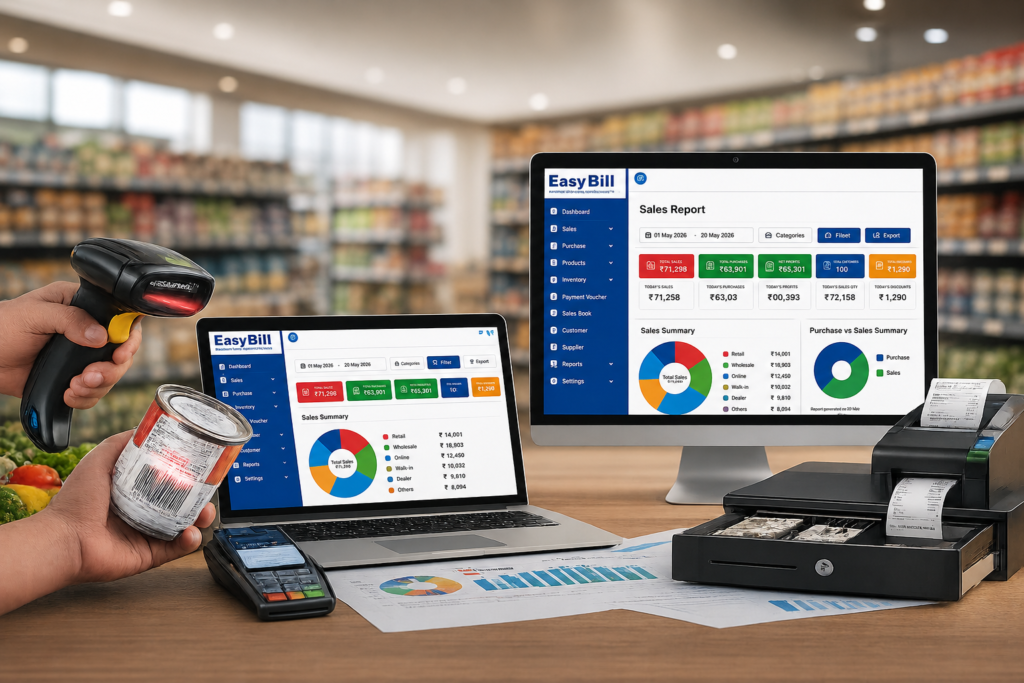
POS Software in Odisha: 7 Smart Buying Tips for Your Business
POS Software in Odisha should make billing and stock management easier, not create another complicated process for your staff. The right system connects billing, inventory, payments and reports so a sale does not have to be entered again somewhere else.
Quick answer: Choose a POS Software in Odisha by testing your real business workflow, not by counting features. During a demo, take an actual product, create the bill, check GST, record payment, verify the stock movement, test a return and open the related report. That short test tells you far more than a brochure.
Table of Contents
- What should POS software actually do?
- Which features deserve your attention?
- Which POS setup fits your Odisha business?
- How should you compare POS Software in Odishas?
- What should you ask the vendor?
- Where does EasyBill fit?
- Frequently asked questions
What should POS software actually do?
A POS Software in Odisha starts with a sale. The useful part is what happens to that sale afterwards.
The product should be recorded, the invoice generated, payment captured, inventory updated and the transaction included in the relevant reports. If your cashier creates a bill in one place and then manually changes stock in another, you are still doing part of the work yourself.
That is the first test I recommend for POS Software in Odisha.
Is POS software the same as billing software?
Not exactly. Billing software mainly handles invoices and sales. POS software usually puts the checkout process at the centre and connects product selection, billing, payment and stock movement.
The label matters less than the workflow. If one transaction flows correctly through the system, that is what matters.
Which features deserve your attention?
Don’t start with a long feature list. Start with the work your cashier and owner actually do.
1. Fast billing and barcode support
A busy counter should not depend on typing every product name manually. If your products use barcodes, test the scanner with your own products.
Demo test: load products your staff really sells and create a normal invoice. Don’t rely only on sample products supplied by the vendor.
2. Inventory should follow every sale
For an inventory-driven business, billing and stock need to agree.
Check current stock, product-wise stock, purchase records, sales records, low-stock alerts, barcode or SKU handling and inventory reports.
Then do the simplest test: sell one product and immediately check its stock record. If it does not match, ask the vendor to explain the workflow before you proceed.
3. GST billing needs a real test
Don’t stop at a “GST ready” label. Create an invoice using your actual business details and products.
Check the tax calculation, HSN/SAC information, invoice format and relevant GST reporting. For official information, use the GST Portal.
For tax-specific requirements, confirm the setup with your accountant or tax professional.
4. Reports should answer business questions
A dashboard full of charts is not necessarily useful.
Ask simple questions: What sold today? What is in stock? What did we purchase? Which customers have outstanding payments?
Create sample transactions during the demo and ask the vendor to find the answers from the resulting reports.
Which POS setup fits your Odisha business?
A pharmacy does not work like a grocery shop. A restaurant does not work like a hardware store. Your business type should decide what you test.
Retail and general stores
Test fast product search, barcode billing, GST invoicing, stock management, customer records, payment tracking and sales reports.
My recommendation: prioritise a system where billing and inventory stay connected.
Grocery and supermarket stores
Grocery counters need quick product selection and dependable stock updates. Test barcode scanning, product search, weighing workflows where required, purchase receiving and low-stock alerts.
Demo test: use your fastest-moving products and recreate a normal counter sale.
Pharmacy and medical stores
Pharmacy inventory needs more detail than ordinary retail. Batch information, expiry tracking, purchases and stock control should be part of the demo.
My recommendation: ask the vendor to demonstrate the exact medicine workflow your store needs instead of accepting a generic retail demo.
Optical stores
Frames, lenses and sunglasses have different product requirements. Use your own products during the demo and check billing, inventory and customer records.
Demo test: create a customer record, add the relevant product details, generate the bill and then check the inventory record.
Optical Shop Management Software
Hardware and electronics stores
Large SKU counts make product search and stock visibility more important. Test barcode support, purchasing, supplier records, stock and sales reporting.
My recommendation: put inventory control ahead of decorative dashboard features.
Hardware Inventory Management Software
Wholesale and distribution businesses
Wholesale operations need more than a quick retail invoice. Test purchases, sales, customer balances, supplier records, inventory and payment tracking.
Demo test: create a customer account, make a credit sale, receive a payment and check the resulting ledger.
Restaurants and cafés
Restaurant POS follows a different workflow. KOT, tables, kitchen operations, takeaway and delivery requirements need their own demo.
Demo test: place an order → send it to the kitchen → modify it if required → generate the bill → record payment.
How should you compare POS Software in Odishas?
Don’t compare software by counting checkboxes. Run one complete transaction from start to finish.
Step 1: Use your actual products
Take products your employees sell regularly. Put them into the demo and test product search.
Step 2: Create a normal invoice
Use your actual prices and tax requirements. Check the final invoice before moving on.
Step 3: Check the stock
After saving the sale, open the inventory record. The stock movement should match the transaction.
Step 4: Record the payment
Use the payment methods your business actually accepts. Then find that transaction in the relevant report.
Step 5: Test a return
Ask the vendor to demonstrate a sales return, cancelled invoice, stock reversal, price correction, user permissions and transaction history.
Step 6: Open the reports
Create sample transactions and ask the vendor to show sales, stock and payment reports based on that data.
What should you ask a POS vendor before buying?
Data backup: How is business data backed up and recovered?
User permissions: Can cashiers and managers have different access?
Hardware: Which barcode scanners, printers and weighing devices are supported?
Internet: What happens if the internet connection goes down?
Multiple outlets: How are branches and stock handled?
Migration: Can existing product and customer data be imported?
Support: What support is available after setup?
Training: Who will train your staff?
Where does EasyBill fit for an Odisha business?
EasyBill positions itself as more than an invoice generator. Its published product information covers billing, inventory and stock management, barcode billing, customer and supplier management, purchase and sales tracking, expense management, multi-user access, data backup and business reporting.
Its retail solution also covers POS billing, GST invoicing, inventory control and real-time reports.
That makes it worth testing if your requirement is billing + inventory + business management, rather than just invoice printing.
The test should still match your business. A grocery shop should test grocery billing. A pharmacy should test batch and expiry workflows. A hardware shop should test SKU and stock handling. A distributor should test purchasing, sales and payments.
That’s a better way to choose software than comparing feature counts.
What do buyers ask about POS software?
What is POS software used for?
POS software records sales at the point of purchase and connects the transaction with related functions such as inventory, payments and business reports.
Is POS software different from billing software?
Yes, although the two overlap. Billing software primarily handles invoices and sales, while POS software usually centres on the complete checkout process.
What features should an Odisha retail shop look for?
Start with fast billing, barcode support, GST invoicing, inventory updates, payment recording and useful reports. Then test returns and user permissions.
How do I choose POS software for my business in Odisha?
Start with your actual workflow. Use your own products during a demo and test billing, GST, payments, inventory and reports from one transaction.
Can POS software work without the internet?
Some POS Software in Odishas offer offline billing, while others depend more heavily on cloud connectivity. Ask the vendor to demonstrate exactly what happens during an internet outage using the setup you plan to buy.
Should price be the first deciding factor?
No. Compare the complete operating fit first. A cheaper system is not a good deal if it creates extra manual work for your staff.
Key takeaway: test the transaction, not the feature list
If you’re shortlisting POS Software in Odisha, start with your own business rather than the vendor’s brochure.
Take one real product. Bill it. Check GST. Record the payment. Verify the stock. Open the report. Then test a return.
If the workflow feels natural for your staff, move on to pricing, support and hardware compatibility.
For businesses that need billing, inventory and reporting in one system, EasyBill ERP is worth putting on the shortlist and testing with your own products and workflow.
Get a Free Demo
Want to see how EasyBill fits your business? Use your actual products and ask for a demonstration of the complete billing-to-inventory workflow.
Published: August 27, 2026
Author: EasyBill ERP