
Last updated: August 25, 2026
Quick answer: Pharma distribution software helps distributors manage medicines, batches, expiry dates, purchase orders, suppliers, retailers, invoices, stock and deliveries in one connected workflow.
Definition: Pharma distribution software is a digital system designed to manage pharmaceutical wholesale distribution, inventory, orders, billing and delivery operations.
Pharma distribution is a fast-moving business where accuracy matters at every step. Distributors have to manage medicines, batches, expiry dates, purchase orders, suppliers, retailers, invoices, GST records, stock levels, payments and deliveries—often across hundreds or thousands of products. A small stock or billing mistake can quickly become a costly operational problem.
That is where pharma distribution software can make a real difference. Instead of managing orders, inventory and accounts through separate registers or spreadsheets, distributors can bring important operations into one connected system. The result is better visibility, faster order processing and more organized day-to-day management.
In this guide, we explain what pharma distribution software is, how it works, which features matter most, how it can improve pharmaceutical distribution and what to check before choosing a solution.
What Is Pharma Distribution Software?
Pharma distribution software is a business management system designed for pharmaceutical distributors, wholesalers, stockists and medicine suppliers. It helps manage the complete distribution workflow, from purchasing medicines from suppliers to selling and delivering them to pharmacies, hospitals, clinics or other business customers.
A good system can connect inventory, purchase management, sales orders, invoicing, batch tracking, expiry management, customer accounts, supplier records and reports. This reduces duplicate data entry and gives the distributor a clearer view of business activity.
Why Do Pharmaceutical Distributors Need Distribution Software?
Pharmaceutical distribution is different from ordinary retail because inventory can involve multiple batches, expiry dates, purchase prices, selling rates, schemes, customers and suppliers. Managing these details manually becomes increasingly difficult as the business grows.
- Large and frequently changing medicine inventories
- Batch-wise stock management
- Expiry date monitoring
- High-volume purchase and sales transactions
- GST invoicing and business records
- Retailer and customer account management
- Supplier and purchase tracking
- Credit and payment management
- Fast order processing and dispatch
- Sales, stock and profitability reporting
Pharma distribution software brings these activities into a more structured workflow so teams can spend less time searching through paperwork and more time serving customers.
How Does Pharma Distribution Software Work?
The basic workflow starts when a distributor purchases medicines from a manufacturer or supplier. Product details, quantities, batch numbers, expiry dates and purchase information are recorded in the system. When retailers or other customers place orders, the distributor can create sales orders and invoices from the available stock.
- Add medicines, suppliers and customer information.
- Record purchases and incoming inventory.
- Capture batch, expiry and pricing information.
- Receive customer orders.
- Check available inventory before dispatch.
- Create sales invoices and applicable tax details.
- Update stock after the transaction.
- Track customer balances and payments.
- Review sales, purchase and inventory reports.
Because these activities are connected, a sale can update inventory and customer records without requiring the same information to be entered repeatedly.
15 Powerful Features of Pharma Distribution Software
1. Pharmaceutical Inventory Management
Inventory is the heart of pharmaceutical distribution. The software should provide a clear view of available stock, product movement, purchases and sales. This helps distributors understand what is available and where replenishment may be required.
2. Batch-Wise Stock Tracking
The same medicine can be available in several batches with different expiry dates and purchase costs. Batch-wise tracking makes it easier to identify the correct stock and maintain organized transaction records.
3. Medicine Expiry Management
Expiry information should remain connected with inventory. A distribution system can help users identify stock approaching expiry so the team can review it according to its internal inventory process.
4. Purchase Management
Record purchase invoices, suppliers, quantities, rates and incoming stock in one place. Better purchase records help distributors understand purchasing patterns and maintain more accurate inventory.
5. Sales Order Management
Distributors may receive frequent orders from pharmacies and retailers. A structured order workflow can help teams process orders faster and reduce manual mistakes.
6. Fast GST Billing
Billing software can help generate professional invoices with configured tax details. Businesses should always verify current GST requirements through the official GST portal.
7. Barcode Support
Barcode scanning can speed up product identification and reduce manual entry. This is particularly useful when distributors handle a large number of SKUs.
8. Customer and Retailer Management
Maintain retailer, pharmacy, hospital or clinic information along with transaction history. Searchable customer records make repeat orders and account reviews easier.
9. Supplier Management
Keep supplier information and purchase history organized. This can help teams review previous purchases and manage supplier relationships more efficiently.
10. Credit and Payment Tracking
Many distribution businesses operate on credit. A connected system can help track invoices, outstanding balances and payment records so owners have better visibility over receivables.
11. Sales and Purchase Reports
Reports help distributors understand sales performance, purchase activity, stock movement and customer transactions. Better reporting supports more informed business decisions.
12. Low-Stock Monitoring
Low-stock visibility helps distributors identify products that may need replenishment. This can reduce the risk of losing sales because fast-moving medicines are unavailable.
13. Return Management
Returns can occur for several operational reasons. A suitable distribution system should make it easier to record returned products and keep inventory records aligned with actual stock.
14. Multi-User Access
Sales teams, billing staff, warehouse employees and managers may need different access levels. Role-based access can help control who can view or modify different business functions.
15. Business Dashboard
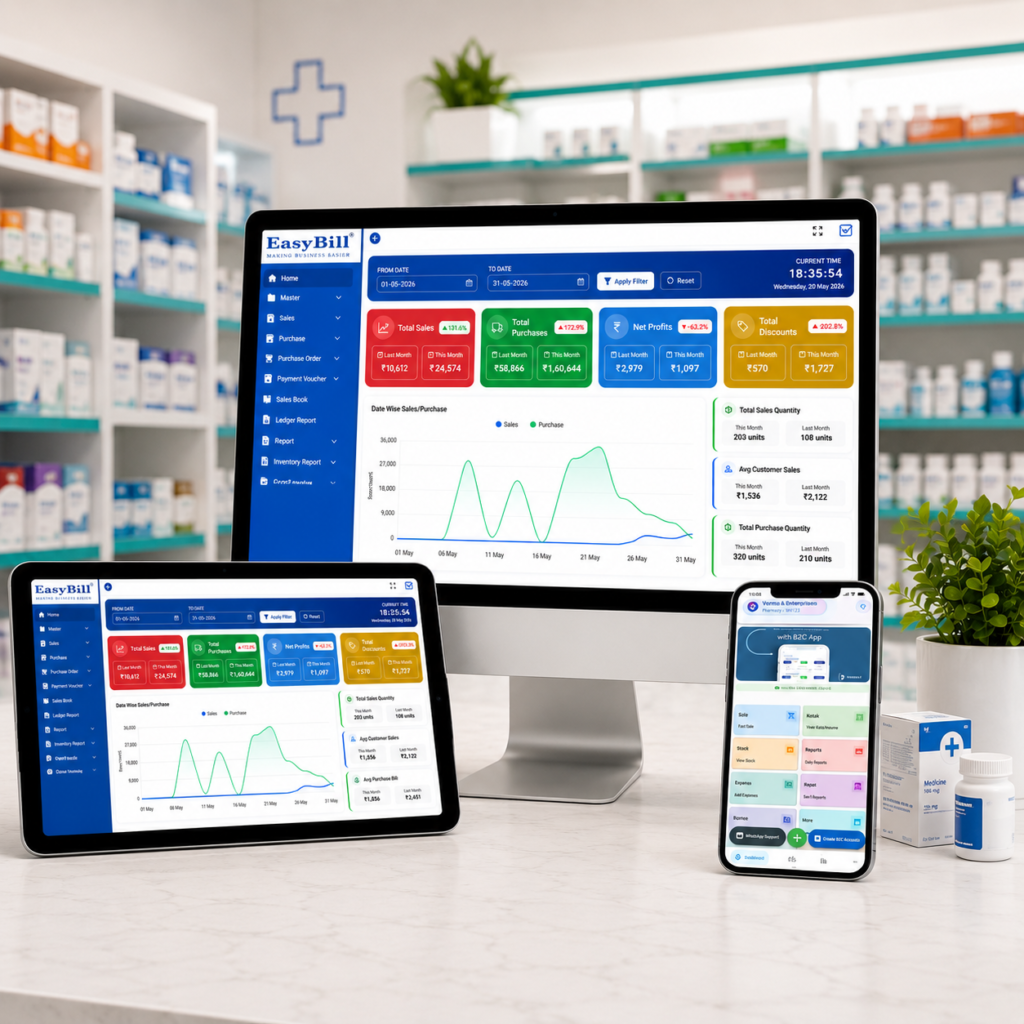
A dashboard can provide a quick overview of sales, purchases, inventory and receivables. Instead of checking several registers, managers can start with a consolidated view of important business information.
Benefits of Pharma Distribution Software
The biggest benefit is not simply automation. It is the connection between different parts of the distribution business.
- Faster order processing: Reduce repetitive manual steps when creating orders and invoices.
- Better stock visibility: Know what is available before accepting or dispatching an order.
- Improved expiry control: Keep expiry information connected with medicine inventory.
- Fewer manual errors: Reduce repeated data entry across separate registers.
- Better financial visibility: Track sales, purchases and customer balances more systematically.
- Smarter purchasing: Use sales and inventory data to support replenishment decisions.
- Scalable operations: Support growth in products, customers, staff and branches.
Pharma Distribution Software vs Manual Management
| Business Area | Manual Management | Distribution Software |
|---|---|---|
| Inventory | Registers and spreadsheets | Centralized digital records |
| Batch tracking | Time-consuming | Organized batch records |
| Expiry monitoring | Manual checking | Digital expiry information |
| Orders | Multiple manual steps | Structured order workflow |
| Billing | Manual data entry | Faster connected billing |
| Reports | Manual preparation | System-generated reports where supported |
| Customer balances | Separate records | Centralized account history |
How to Choose the Best Pharma Distribution Software
Do not select software only because it offers billing. Pharmaceutical distribution needs a complete workflow covering inventory, purchases, sales and customer accounts. Before making a decision, check these areas:
- Pharmacy and distribution focus: Does the software understand medicine-related inventory requirements?
- Batch and expiry support: Can your team easily record and review batch and expiry information?
- Inventory accuracy: Does sales and purchase activity update stock correctly?
- Order management: Can your sales team process regular retailer orders efficiently?
- Billing: Does it support the invoice and tax workflow your business requires?
- Receivables: Can you monitor customer credit and outstanding balances?
- Reports: Are sales, purchase, inventory and customer reports easy to access?
- Ease of use: Can employees learn the system without excessive training?
- Scalability: Can it support more products, users and branches as you grow?
- Support: Is reliable technical and product assistance available?
Pharma Distribution Software and Pharma Billing Software: What Is the Difference?
Pharma billing software mainly focuses on creating medicine sales invoices and connecting billing with inventory and related pharmacy operations. Pharma distribution software goes further by supporting the wider wholesale and distribution workflow, including customer orders, retailer accounts, supplier management, purchase operations, receivables and distribution reporting.
For many businesses, the two functions overlap. A strong distribution platform should therefore include reliable billing and inventory capabilities rather than treating billing as a separate process.
If you are primarily looking for pharmacy billing, explore our pharmacy billing software resource. For a broader pharmacy workflow, our Ultimate Pharma Billing Software Guide covers billing, inventory, batches and pharmacy management.
How EasyBill ERP Can Help
EasyBill ERP brings billing, inventory and business management into one platform. For businesses that need pharmacy-focused operations, the EasyBill ERP Pharmacy Billing Software solution can help connect billing, POS sales, inventory and purchase-related records.
For distributors, the most important consideration is whether the software fits the actual order-to-invoice workflow, inventory process and customer-account structure of the business. Before implementation, map your current process and verify that the selected features support it.
Best Practices for Pharmaceutical Distribution Management
Software delivers the best results when the underlying process is disciplined. Keep product masters accurate, record purchase information carefully, verify batch and expiry data, reconcile physical stock regularly and review customer balances on a defined schedule.
It is also useful to analyze fast-moving and slow-moving medicines. Strong sales data can support better purchasing decisions, while inventory and expiry reports can help teams identify stock that needs attention.
Frequently Asked Questions About Pharma Distribution Software
What is pharma distribution software?
Pharma distribution software is a business management system designed for pharmaceutical distributors, wholesalers and stockists. It can manage inventory, purchases, sales orders, billing, customers, suppliers, payments and reports.
What is the best software for pharmaceutical distributors?
The best software depends on the distributor’s products, transaction volume, customers, branches and workflow. Look for strong inventory, batch and expiry tracking, order management, billing, receivables, reports, usability and support.
Can pharma distribution software manage medicine inventory?
Yes. Distribution-focused systems can manage medicine stock and may include batch tracking, expiry information, purchases, sales, low-stock monitoring and inventory reports.
Can pharma distribution software handle GST billing?
Many business systems provide GST-related invoicing features. The exact functionality depends on the product configuration, and businesses should verify current tax requirements through official GST guidance.
Is pharma distribution software useful for small distributors?
Yes. Small distributors can benefit from organized inventory, faster billing, customer account tracking and better reports. A scalable solution can also support growth without requiring a complete system change later.
Does pharma distribution software track batches and expiry dates?
Pharmaceutical-focused systems commonly provide batch and expiry management. Before purchasing, confirm the exact batch-level and expiry workflow offered by the software.
Can pharma distribution software manage retailers and pharmacies?
Yes. A distribution system can maintain customer records, order history, invoices, balances and other information for pharmacies, retailers, hospitals or clinics, depending on its features.
Why is inventory management important in pharmaceutical distribution?
Accurate inventory helps distributors understand available stock, reduce unnecessary manual checking, support purchasing decisions and improve order fulfillment. Batch and expiry information make inventory management especially important for medicine businesses.
Final Takeaway
Pharma distribution software is more than a billing tool. It is a connected business system that can bring pharmaceutical inventory, purchases, sales orders, billing, customers, suppliers, payments and reporting into one workflow.
For a growing pharmaceutical distributor, the right solution can make everyday operations more organized, improve stock visibility and give managers better information for purchasing and sales decisions. The key is to choose software that matches the real workflow of your distribution business—not simply the software with the longest feature list.
For authoritative GST information, always verify current rules and requirements on the official GST portal.